
SAIF AI Factory
One platform to prepare medical data for AI: ingest and structure it, then label, train, and validate, in the cloud or on your own servers.
SAIF, the Saudi AI Factory, is where medical AI gets built. It brings raw medical data in, removes Protected Health Information, structures it, and gives clinical experts the tools to label it, then supports model training and validation on the same platform. We built it for our own models, and now license it to AI teams, researchers, and healthcare organizations in Saudi Arabia and the region.
What SAIF does
Ingest Medical Data
Bring in X-ray, CT, MRI, and retinal images in 2D and 3D, directly from PACS or as DICOM, NIfTI, JPEG, PNG files.
Structure and De-identify
Patient identity is removed and data is organized into consistent datasets before labelling starts.
Label Faster, With AI Assistance
Bounding box, polygon, brush, spline, keypoint, and measurement tools, from classification to pixel-level segmentation. AI pre-annotation speeds up each project as it learns.
Clinical Quality Review
Peer, blind, and double-reading review, with AI checks that catch inconsistencies before a dataset is finished.
Train and Validate
Use the labelled data to train models and validate their performance on the same platform.
Teams, Security, and Deployment
Role-based teams, live project tracking, and deployment in the cloud or on your own servers, with data kept in the Kingdom.
From labelling project to reviewed image.
Every labelling project in your organization.
The project dashboard shows every labelling project in your organization and how far each one has got: images labelled, what is in progress, and what is still to start.
Where labellers do their work.
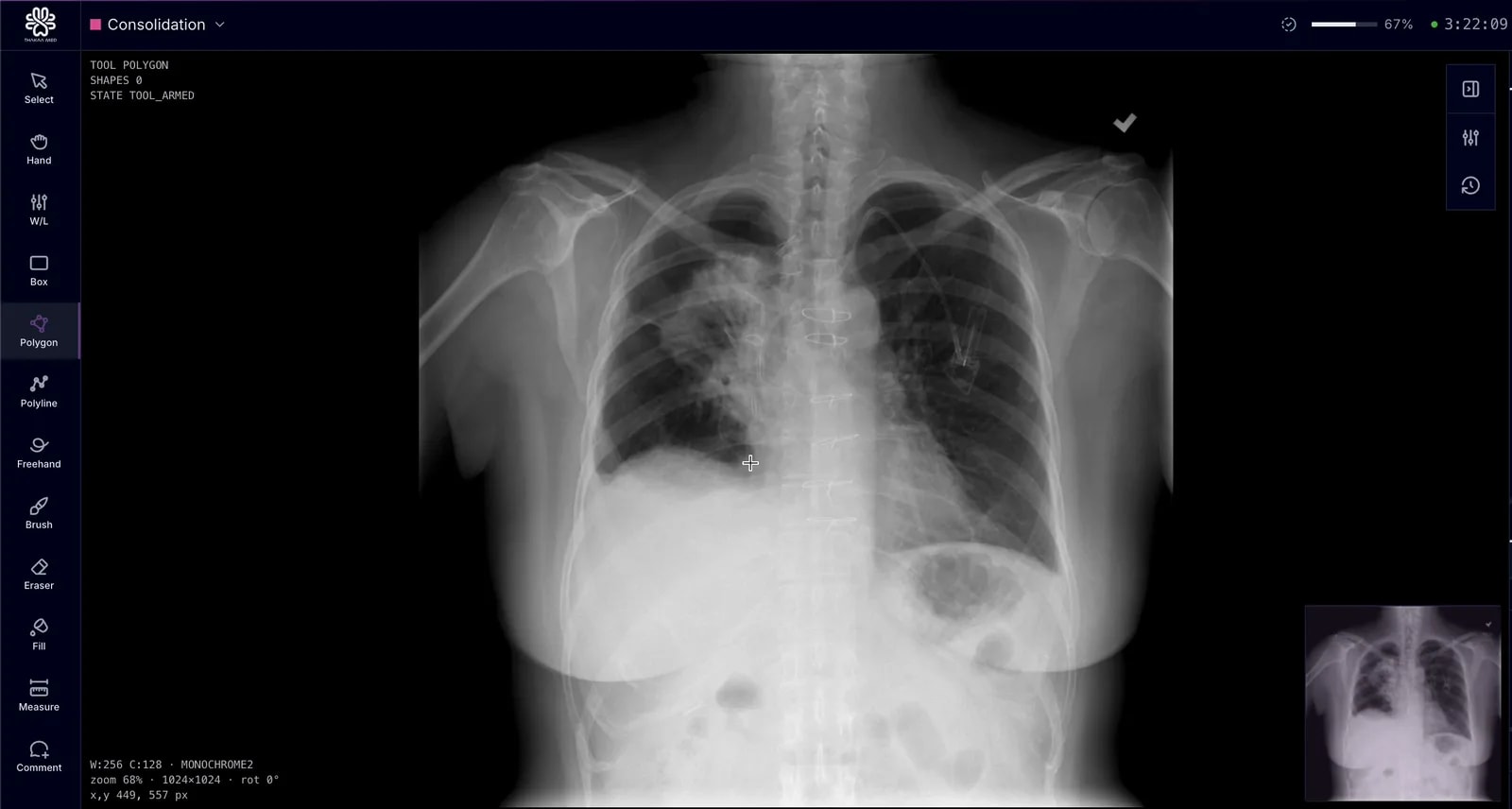
Labellers annotate each image with polygons, brushes and measurements, add comments and tags, and send their work for review, all in one workspace.
Why teams use SAIF.
Datasets You Can Trust
Multi-level clinical review gives every dataset the consistency medical AI needs.
Faster Projects
AI-assisted labelling and live project tracking shorten every stage, from the first image to the finished dataset.
Proven on Our Own Models
SAIF prepared the data behind Dental IQ, which holds SFDA authorization. It's the same platform you license.
The details
Modalities supported+
X-ray, CT, MRI, mammography, retinal imaging, dental imaging, and ultrasound. 2D and 3D imaging both supported, with native DICOM, NIFTI, and PACS connectivity.
Annotation toolset+
Bounding box, polygon, brush, spline, keypoint, measurement, classification labels, and free-form notes. Pixel-level segmentation and 3D volumetric annotation are available for the modalities that require them.
Quality control+
Multi-tier review pipeline (peer, blind, double-reading), automated consistency checks, inter-annotator agreement metrics, and dashboards for project-level QA reporting.
Deployment model+
Cloud, on-premise, or hybrid. Regulated healthcare customers typically deploy on-premise to keep clinical data inside their security perimeter.
Integration interfaces+
DICOM C-STORE and C-FIND for image ingestion, PACS adapters for direct study pull, REST APIs for dataset export, and S3-compatible storage targets for downstream training pipelines.
Security posture+
AES-256 at rest, TLS 1.3 in transit, RBAC, comprehensive audit logging. On-prem deployments isolate from the public internet by default; cloud deployments support Saudi-region data residency for PDPL alignment.
Throughput envelope+
Project-level throughput is set by your annotator headcount and modality complexity; smart segmentation reduces per-image time by ~60% on supported tasks.
Fits into the systems you already run
PACS
DICOM-native ingestion from any major PACS.
Storage
S3-compatible export targets for downstream model training pipelines.
Training Stack
Exports compatible with major medical-AI training frameworks.
On-premise
Self-hosted deployment for regulated environments needing full-tenant isolation.
Cloud
Saudi-region cloud deployment, PDPL-aligned.
Frequently Asked Questions
Customers typically see annotation cost reductions of 30–40%, project completion in weeks instead of months, and substantial improvements in downstream model performance. The ROI compounds as smart-segmentation models adapt to your specific use cases over time.
Read more
The ROI of Advanced Medical Image Labelling — Beyond the Numbers
When healthcare organizations evaluate investments in advanced technologies, return on investment (ROI) naturally becomes a central consideration. However, calculating the ROI of medical image labelling platforms…
How SAIF Is Transforming Medical Image Labelling — A Vision for Healthcare AI
The development of artificial intelligence in healthcare faces a fundamental challenge: the data bottleneck. While AI algorithms continue to advance rapidly, the creation of high-quality training datasets remains a…
Built on a clinical-grade foundation
Medical-device quality management system
Information security management system in implementation
Developed under an IEC 62304-compliant software lifecycle
On-premise or Saudi-region deployment — customer's choice
Encryption at rest; TLS 1.3 in transit
Saudi Personal Data Protection Law compliance
Clinical data exchange on the FHIR R4 standard
Native DICOM imaging interoperability